
Concrete lifting is the repair you consider when a sidewalk turns into a trip hazard, a patio slopes toward the house, or your driveway has a step big enough to catch a snow shovel. The basic idea is simple: raise the sunken slab instead of demolishing it and pouring a new one. The execution is where things get interesting.
I have seen homeowners spend money twice because they treated a drainage problem as a concrete problem. Before you drill holes or call the first contractor in a search result, figure out why the slab moved, what sits underneath it, and whether the concrete is still sound enough to save.
What concrete lifting actually fixes
Concrete settles when the soil below it loses volume, washes away, or was poorly compacted in the first place. Downspout discharge is a common culprit. So is backfill around a newer addition, where loose soil slowly compresses under a walkway or porch. Freeze-thaw movement can make the height difference worse, especially in northern states.
Lifting can correct a vertical drop and restore drainage. It can make a three-inch sidewalk lip nearly flush, bring a garage apron closer to the garage floor, or move a patio away from the foundation so rainwater stops sitting against the wall. It does not repair badly cracked concrete, crumbling edges, or a slab that is breaking into separate pieces.
The first measurement is the most useful one: check the height difference at both ends of the settled section. Then look for cracks, hollow areas, standing water, and gaps along the foundation. A slab that is structurally intact but low is a good candidate. A slab that looks like a jigsaw puzzle usually needs replacement.
Mudjacking versus polyurethane foam
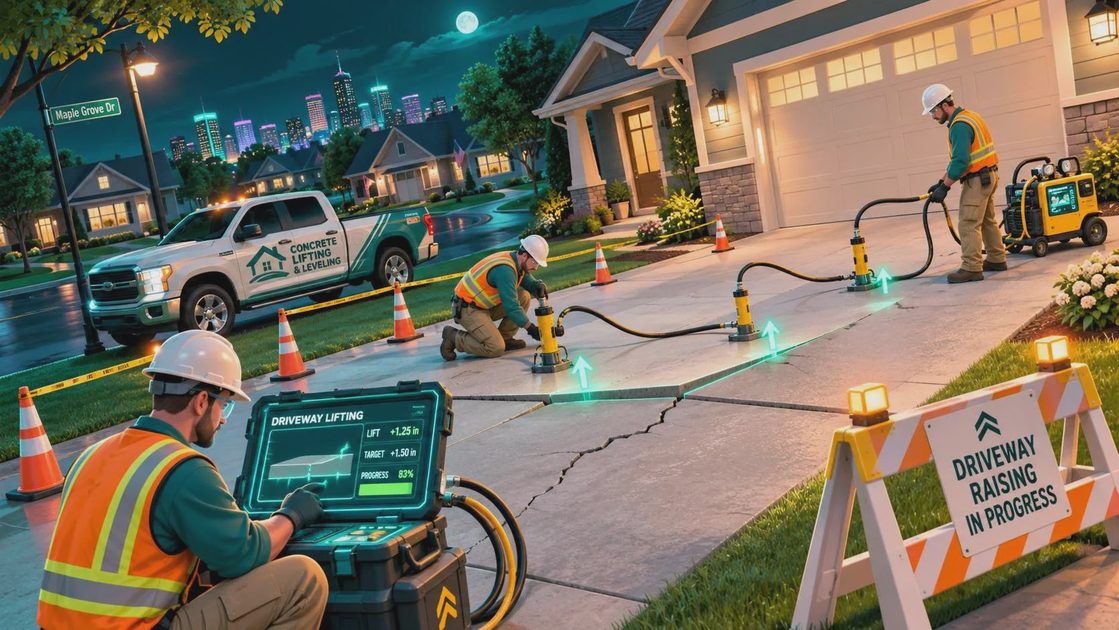
Traditional mudjacking pumps a cement-based slurry through holes drilled in the slab. The material fills voids and pushes the concrete upward. It is proven, widely available, and often costs less than foam. The downside is weight. A slurry can add several thousand pounds beneath a large driveway section, which is not ideal when the underlying soil is weak or wet.
Polyurethane foam lifting uses smaller injection holes and a lightweight expanding foam. The foam fills voids and raises the slab with less added weight. Contractors can often finish a residential walkway or driveway in a few hours, and the holes are usually less noticeable after patching. Foam is not magic, though. It still needs a stable soil layer to push against, and excessive injection can lift one edge too far.
For a small walkway, either method can work. I tend to favor foam where access is tight, the soil is questionable, or the slab is close to a foundation wall. Mudjacking remains reasonable for large, thick slabs where the contractor has a clear plan for controlling the slurry.
How much concrete lifting costs
Prices depend on the slab size, the amount of settlement, access, material, and the local labor market. As a rough residential range, a small walkway repair may run $500 to $1,200. A patio or several sidewalk sections commonly lands around $1,000 to $3,000. Driveway work can reach $2,000 to $6,000 or more when multiple sections have dropped and the crew must work around vehicles, landscaping, or tight property lines.
Foam usually costs more per project than mudjacking, but the final bill is not calculated by material alone. A contractor may charge a minimum mobilization fee, drilling fee, or cleanup charge. Ask whether crack sealing, hole patching, soil correction, and drainage changes are included. A $900 quote that excludes the downspout problem is not cheaper if the slab sinks again next spring.
Replacement can cost substantially more. Removing and disposing of old concrete, preparing the base, adding reinforcement where appropriate, and pouring a new slab often pushes a modest project into the $3,000 to $8,000 range. Replacement is still the right answer when the concrete itself is failing.

The drainage work that should happen first
Before concrete lifting, redirect every downspout that empties near the settled area. Use extensions long enough to discharge on stable ground away from the foundation, and make sure the outlet does not send water toward a neighbor or across a walking path. Check hose bibs, irrigation lines, sump discharge, and nearby grading as well.
I once looked at a patio that had been lifted twice. The owner blamed the contractor, but the real problem was a buried downspout leaking beneath the slab. Water was carrying fine soil away every time it rained. The third repair included a new solid drain line and a corrected outlet. That repair held because the water had somewhere else to go.
Do not let a crew inject material into saturated soil without discussing the cause. Raising the slab can make it look right for a while, but it does not replace missing drainage or compacted base material. Concrete lifting fixes the elevation; it does not automatically fix the site.
How to evaluate a lifting contractor
Ask how the crew will determine the final elevation before they start. A good contractor should discuss nearby thresholds, garage floors, door swings, drainage slope, and adjacent slabs. For a walkway, the goal is not simply “as high as possible.” The finished surface needs a useful slope and a transition that will not create another trip edge.
Request a written scope showing the injection material, approximate hole pattern, patching method, cleanup, warranty, and exclusions. Confirm that the company carries liability insurance and workers compensation coverage. Concrete lifting involves pressurized equipment, drilling, and heavy materials, so this is not the place for an informal cash arrangement with no paperwork.
Be cautious of anyone promising that every settled slab can be restored perfectly. Some concrete has warped, cracked, or lost its edges. A responsible contractor will point out those limitations before taking a deposit. Compare at least two proposals, but compare the repair plan rather than choosing the lowest number.
When lifting is the wrong repair
Replacement makes more sense when the slab has widespread structural cracking, exposed aggregate, severe scaling, or broken corners throughout. It is also the better choice when the concrete needs a new shape, wider access, embedded drainage, or a different finish. Lifting cannot turn ten-year-old damaged concrete into new concrete.
There are also situations where the slab is not the real issue. If a porch is pulling away from the house, a foundation wall is moving, or a retaining wall is failing, get a structural evaluation before raising anything. A walkway that slopes because the entire structure is shifting needs a different diagnosis.
For a sound slab with a manageable height difference, concrete lifting is usually faster, cleaner, and less disruptive than demolition. For failed concrete or unstable structures, replacement and underlying repair are money better spent.
The bottom line
Concrete lifting is a practical repair, not a shortcut around every concrete failure. Measure the settlement, inspect the slab, correct drainage, and get a written proposal that explains the material and final elevation. Foam is useful in tight residential spaces, while mudjacking can make sense for larger slabs and lower budgets.
Do not start with the injection holes. Start with the water and soil beneath the concrete. Above grade is for the real estate photos. Below grade is where you actually live, and the same rule applies outside: fix what caused the movement before you hide the evidence.


No letters yet — be the first guest to write.